Breath Is the Only Lever Into the Nervous System You Can Pull on Command
21 Dimensions · September 22, 2026 · 5 min read
A group arrives at the hardest conversation of the day carrying whatever physiological state got them there: three back-to-back calls, a delayed flight, a disagreement from yesterday that never resolved. The agenda assumes everyone arrives regulated. Almost nobody does, and by the time the real conversation starts, the room's nervous system is already steering the outcome underneath its stated intentions.
Of everything the autonomic nervous system runs on its own - heart rate, digestion, immune response - breath holds a unique place. It happens automatically, and it can also be taken over deliberately, on command, with a measurable effect on the state behind it. Polyvagal theory and heart rate variability research point at the same mechanism from different directions: a deliberate change in breathing pattern shifts the nervous system's state with it, generally within minutes.
The pathway runs through the vagus nerve. Slow, extended exhales engage the parasympathetic "rest and digest" branch, measurably lowering heart rate and cortisol. Short, shallow breathing under stress does the opposite: it keeps the sympathetic "fight or flight" branch engaged long after the actual threat (a hard email, a tense board meeting) has passed. Most leaders spend the day breathing themselves toward narrower thinking without noticing it.
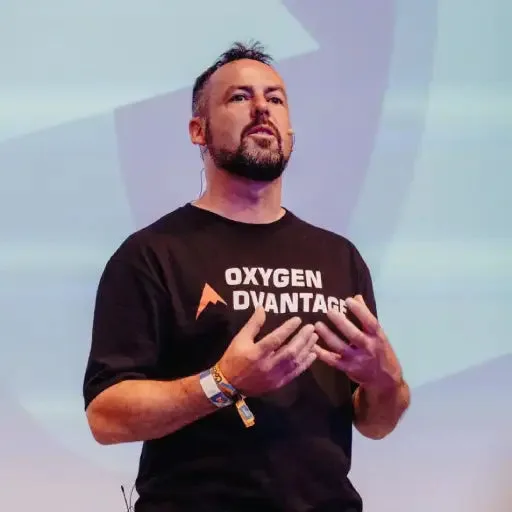
This is established physiology, and it is why breathwork and nervous-system regulation now sit inside executive coaching as named, credible practices. The Wim Hof Method and Patrick McKeown's Oxygen Advantage have each built substantial, testable approaches around this single mechanism: controlled breath as a direct input to cognitive and emotional state.
For an individual leader, the application is narrow and learnable. A longer exhale than inhale to down-regulate before a high-stakes conversation. Slow, nasal breathing to stay in the state where complex thinking is available. Noticing, before reacting, that a held breath is often the first sign that the survival brain has taken over from the part of the brain that does strategy. None of it requires an hour on a cushion.
For a team, the same principle changes where breathwork belongs in an agenda. It usually gets placed at the end of a hard day, as recovery. It earns far more in the ten minutes before the hard conversation, when the room's collective state will decide how well anyone listens, tolerates disagreement, or thinks past their own defensiveness. Fifteen minutes of guided breathing before a pivot or a difficult postmortem sets the physiological conditions the real work is about to happen inside.
On 21 Dimensions, this is what the Breath dimension trains directly, through Box Breathing, Coherent Breathing, Pranayama, the Wim Hof Method and Oxygen Advantage, developing Somatic Intelligence and Energy-Field Intelligence: the capacity to read and shift a physiological state on purpose. At the far end of the same territory, Stanislav Grof's research behind Holotropic Breathwork mapped non-ordinary states reached through breath alone. A room preparing for a hard decision draws on the same principle at a gentler depth: breath is a door into physiological state that is always available and always on command.
Facilitators working in this space